Start with a topic.
Learning Library
Build financial knowledge, then put it to work.
- Explore a concept.
- Check your understanding.
- Practice with support.
- Apply what you learn independently.

For schools & districts
We’re developing a high-school personal finance course where the “why” behind a student’s choice guides targeted learning. Students then apply what they learn to a new financial decision—without hints.
Help shape the courseStarting with California public schools,
charter schools, and districts.
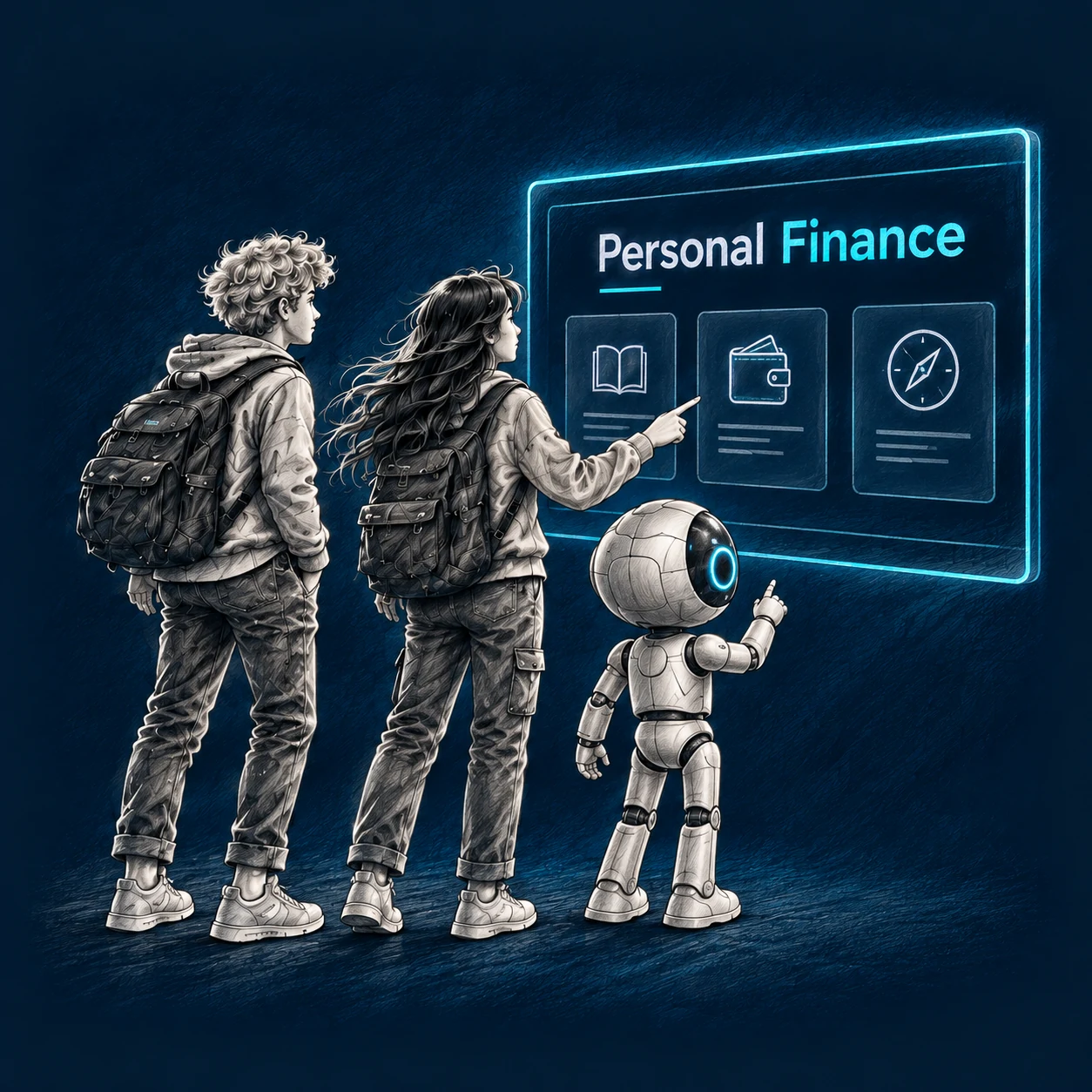
The high-school personal finance course
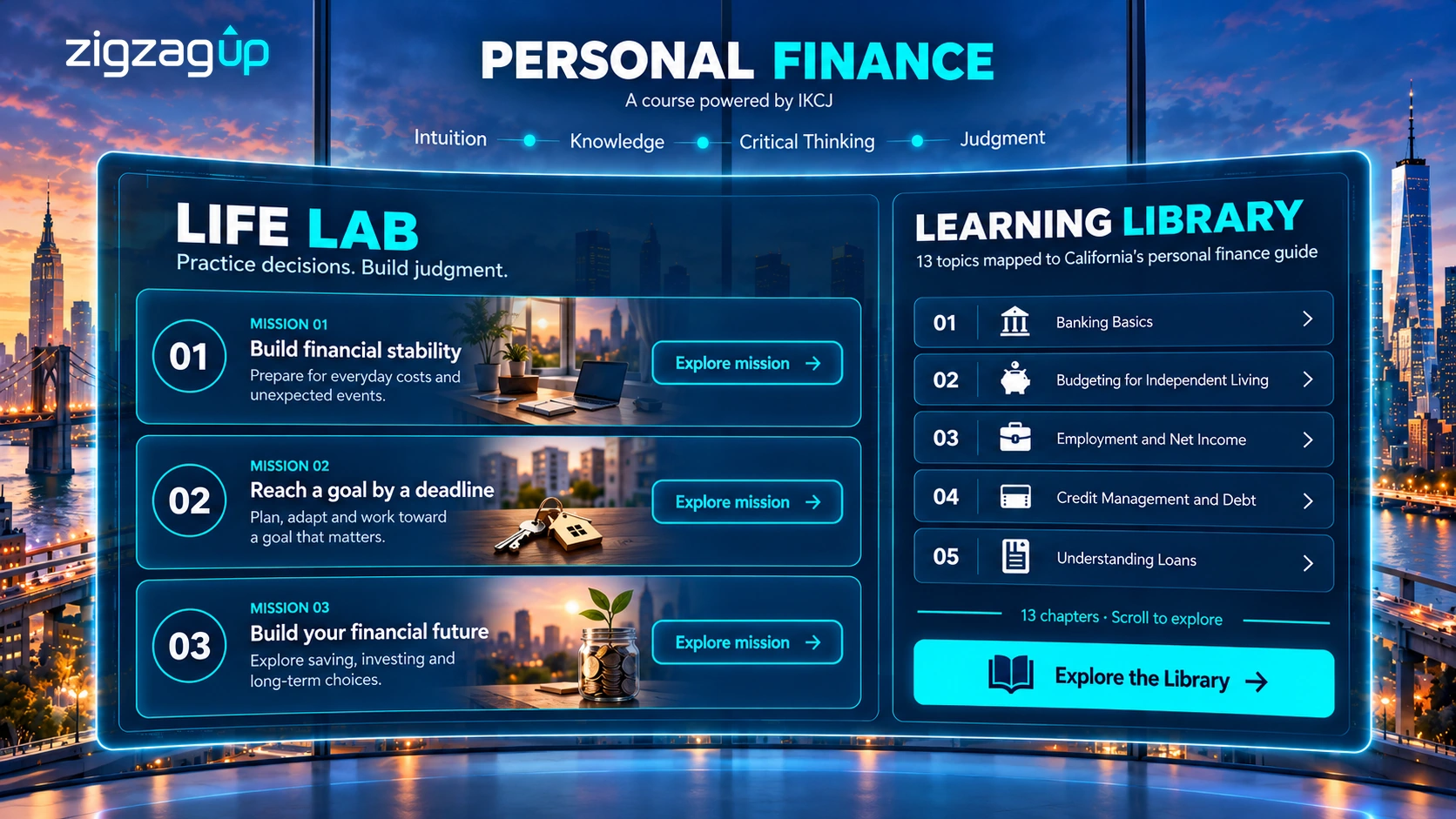
13 planned course chapters, mapped to California’s personal finance topic areas.
Start with a topic.
Build financial knowledge, then put it to work.
Start with a goal.
Three missions connect all 13 topics through goals, changing circumstances, and financial consequences.
Balance everyday needs and prepare for the unexpected.
Plan, adapt, and work toward a goal—like a first apartment.
Explore saving, investing, and longer-term choices.
Start in either. Move between both.
ZigZagUp’s summarized chapter labels, not official state-approved chapter titles. The 13-topic structure underpins both learning paths.
From a first idea to an explained decision
IKCJ: from a first idea to a decision the learner can explain.
What do I think?
What am I missing?
What supports my conclusion?
Can I decide independently?
Choices, confidence, and explanations are intended to guide targeted questions and practice. Later decisions without hints examine independent application.
In development. These are intended capabilities, not validated learning outcomes. Explore the platform approach
Product video coming soon
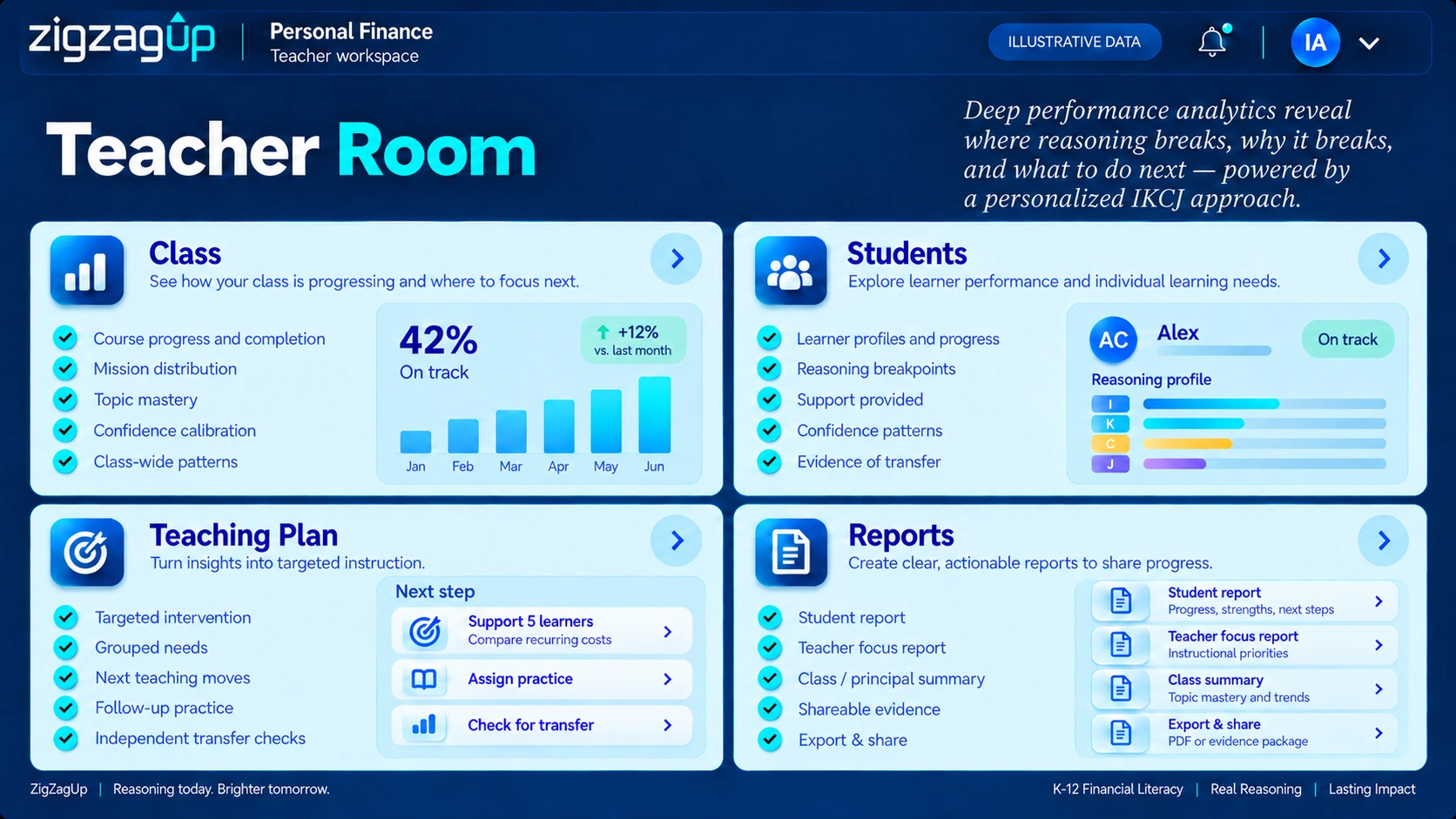
Teacher Room
The planned Teacher Room is designed to help teachers track class and individual progress, identify where support is needed, and decide when and how to intervene.
Shaped with educators
Help shape lesson pacing, classroom activities, teacher tools, and implementation support.
Educator feedback will shape how the Learning Library and Life Lab fit your curriculum, lesson pacing, and teaching priorities.
Participation, scope, timing, teacher preparation, support, and evaluation would be agreed together before a pilot. Sharing feedback does not commit your school or district.
Before students participate, data use, privacy, security, accessibility, and implementation requirements would be documented and reviewed with the school or district.
Built with educators, from the beginning
Teachers and school and district leaders: review the concept and help shape the course around your teaching priorities.
Give feedback on learning activities, teacher tools, and classroom use.
Discuss a suitable scope, timing, and support before deciding whether to participate.
Examine student work and teacher feedback to guide improvements.
Start with feedback. A conversation does not commit your school or district to participate.
Let’s connect
Tell us what matters to your school or district.
Start a conversationpartnerships@zigzagup.appA conversation with the founder
Inna ArboFounder & CEO, ZigZagUpSan Francisco Bay Areainna@zigzagup.appContact the FounderZigZagUp is in development. Classroom pilots are a future step.